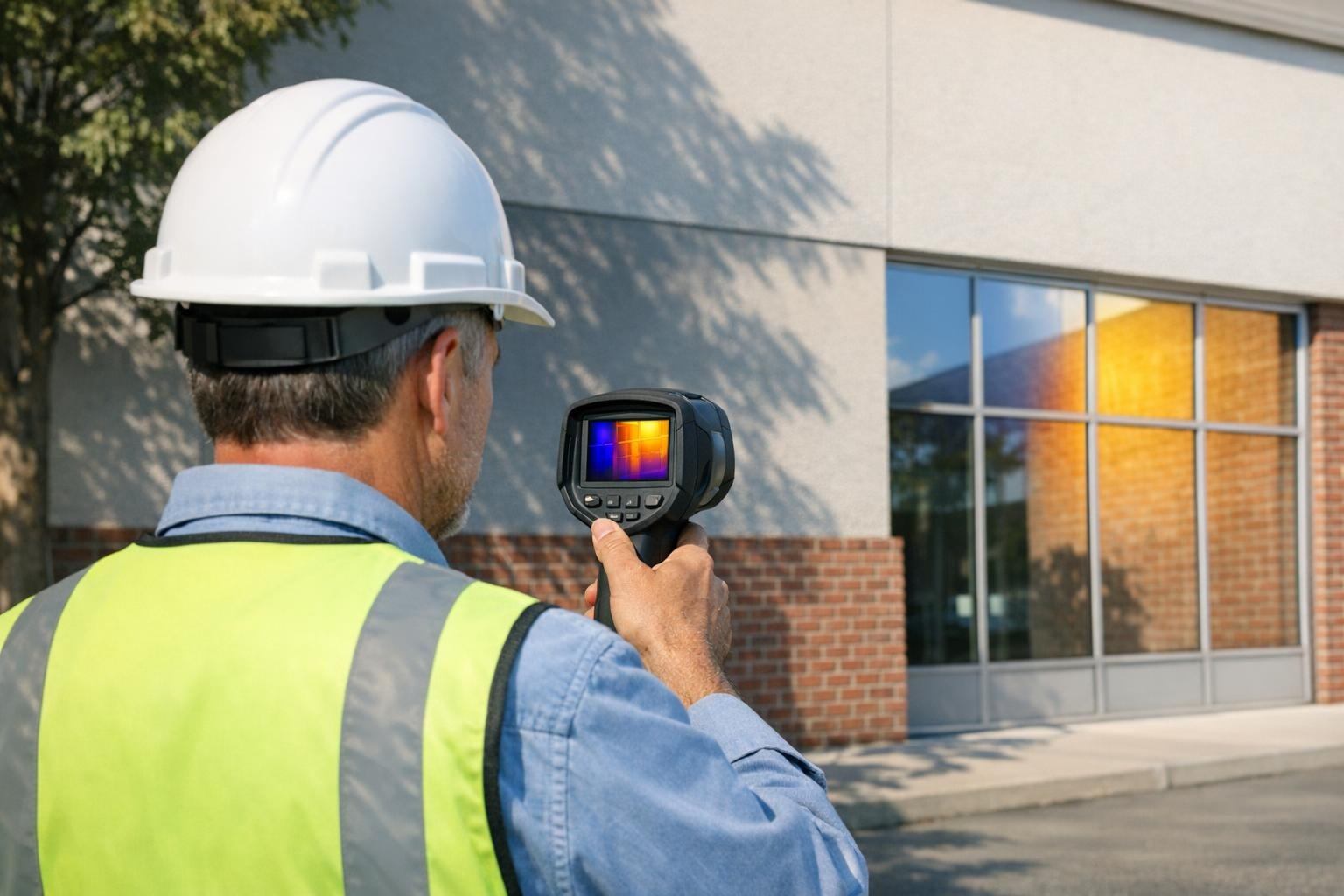
While thermal images of a building's exterior can provide an attractive color image highlighting temperature differences in walls and roofs, these images need to be viewed with a healthy dose of skepticism. Sometimes a seemingly reveals a problem while in reality it reveals nothing of significance. On other occasions a perfectly normal building can be made to look a real problem due to the influence of sunlight on surfaces under test. If used sensibly, thermal imaging can provide very useful information to both owners and potential buyers of a building, but it must be used in conjunction with other information and other inspection methods.
Why direct sun changes the surface story
An infrared camera does not 'look through' building exteriors. The camera takes a picture of the surface of the external walls and shows what the surface temperature of that surface is. Prior to the inspection the sun will have warmed up some surfaces more than others depending on the orientation of the surfaces to the sun.
Even uneven sunlight can cause problems. A wall can receive more sunlight because it is adjacent to a tree, overhang, fence or other building. Window glass, painted metal, glazed brick and smooth finished surfaces can also reflect heat from nearby objects. This can result in an accurate temperature map but misleading results when diagnosing problems.
Important distinctions between the appearance of a warm patch and a cool patch need to be made. A warm patch does not necessarily mean that there is no insulation, and a cool patch does not necessarily mean that there is moisture present.
The timing choice: inspect in sun or wait for shade?
As an alternative, wait for shade. This makes for a cleaner comparison of different wall sections of similar construction. The difference in temperature caused by solar loading is strongest and most notable and therefore must be excluded as far as possible when comparing surfaces of similar construction.
Sunlight can be used to produce controlled temperature differences. This allows changes in heat flow, i.e. deficiencies in insulation, to be detected, and also allows differences in heat flow through adjacent materials to be determined. The differences in heat flow can be large in some cases, but need to be measured under controlled conditions.
You choose the question to be answered. If you are trying to determine if there is a deficit of insulation in a wall then a consistent comparison is more important than a sun affected reading. However, the reading taken when the exterior surface has heated up will give an indication of how the wall behaves post-heating.
When reflected heat looks like a defect
Reflection of heat from surrounding surfaces can also cause problems when trying to determine the temperature of a building's exterior surfaces. A roof cover of dark-colored material can appear hot, while a light-colored roof cover of similar construction on an adjacent building may appear cool. Likewise, windows and metal trim can also cause confusion as they can reflect heat from surrounding surfaces such as roofs, sidewalks, building walls, cars, etc.
Near windows and metal items, for example, a bright reflection could be misinterpreted as a hot spot. Dark finishes could appear to be hot or cold compared to light finishes even though the assemblies behind them are identical. Additionally, the same reflective surface can look very different depending on the angle at which it is viewed.
Heated reflected surfaces can look like hot spots within the building envelope. Checking the suspected area(s) from an alternative view point and by means other than thermal imaging should establish whether reflected surface heat has been misinterpreted as problems within the building fabric.
What a reliable scan should record
For useful sunlight infrared readings to be recorded in the inspection report it is important to note the position of the investigated elevation(s) in relation to direct sun light, partial shade or full shade. Also note recent weather, surface findings and other factors which may affect the results, such as wet cladding, recently cleaned surfaces, open windows, mechanical equipment etc. Nearby heat sources must also be recorded.
When undertaking a building inspection, it is essential to compare like with like. A single image of a dramatic colored patch is of limited use, however, if the same section of wall is repeated on other parts of the building, with the same construction detail, then similar patterns of reading are highly significant.
When images are captured, it is helpful to have photographs of corresponding features to verify that observed temperature variations are not caused by something visible on the outside of the building. Furthermore, signs of previous problems such as cracked sealant, staining or peeling paint help to give due weight to the thermal image findings and provide solid evidence of concealed problems.
Choosing between thermal imaging and other checks
Thermal imaging is generally very useful to assess surface temperature differences and hence to identify issues like surface moisture, poor joint seals, unbalanced wall construction and others. Other diagnostic methods such as visual, moisture measurements etc. are needed to be used to confirm findings in a thermal image.
In many instances other forms of testing are also required to support a finding of suspected defects exposed by the external thermal imaging survey. However, different forms of testing are required to verify different suspected defects. Furthermore, different testing methods are required for different materials and surfaces.
A buyer looking for defects in a property might consider a single scan followed by further investigation of any areas found to have problems. On the other hand, an owner interested in increasing energy efficiency of a building might look at the whole building including walls, windows and penetrations through a series of comparative inspections.
Common mistakes that distort the decision
The first mistake is to treat all warm surfaces as if they are losing heat from within the building. Once the sun has moved off a surface, the surface can remain a different color to the surrounding material for some time and the image must take account of this. Shaded surfaces are often incorrectly assumed to show signs of moisture or poor insulation, whereas in fact the opposite could be true.
It's important to note that many exterior thermal scans are only taken of the most easily accessible surfaces of a property. The result is that images of adjacent walls that have been in shade throughout the time of the survey will typically look very different from sun-exposed surfaces. Moreover, much confusion can arise from ignorance of surface finish, orientation and the presence of objects that can reflect infrared radiation.
There is also a danger of owners and purchasers over-reacting to a single reading. It is sensible to establish in advance what was observed, what alternative explanation there might be for the reading, and what further investigation would confirm or refute the suspected problem. The inspection report should make clear distinction between the observed temperature distribution and any conclusions drawn as to the probable cause.
A practical decision before the appointment
As with any analysis method, make sure you clearly outline the question you wish to have answered prior to arranging the exterior thermal inspection. A clear description of suspected moisture or uneven insulation of building components such as walls, ceiling and roof between structure and cladding as well as suspected heat loss from windows and other openings such as for example doors and Electrical/Mechanical equipment penetrations can help ensure that the most suitable analysis is arranged. It is also important to clarify how sunlight and reflective surfaces are to be treated during the analysis. In cases where the exterior surfaces of a property are to be analyzed but poor sunlight or high levels of reflective surfaces are found to affect the results then it may be more cost effective in the long run to postpone the thermal imaging part of the analysis and use an alternative method of analysis.
It is not the purpose of a thermal infrared survey to produce the most spectacular infrared images but to arrive at a sound finding about the investigated surface(s) and to derive from this the most appropriate measures to be taken from them.